11 min read
The GLP-1 Off-Ramp: Opportunity for Supplement Founders
When consumers stop GLP-1 drugs like Ozempic, rapid weight regain creates a supplement opening. Here's how brand founders can position for the GLP-1 off-ramp.
The preferred form for sleep, stress, and muscle recovery positioning.
Magnesium glycinate (bisglycinate) is the most bioavailable and best-tolerated form of magnesium for supplementation. It dominates sleep, stress, and recovery formulas and commands premium pricing over cheaper magnesium oxide or citrate.
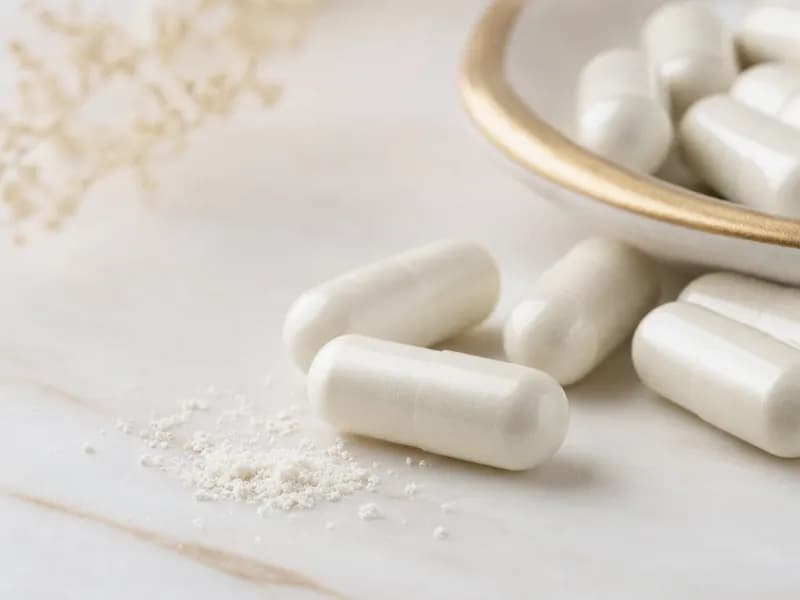
Magnesium is one of the most common micronutrient gaps in North American diets, and consumer awareness around magnesium for sleep and stress has climbed fast over the last few years. Glycinate (sometimes called bisglycinate) is the chelated form. Magnesium bound to the amino acid glycine. It absorbs better than the cheaper forms, it's much easier on the gut, and the glycine itself has calming effects of its own.
For brands, glycinate is the form to use when you're building sleep, relaxation, or recovery formulas. It costs more than oxide or citrate, but the consumer story writes itself: better absorption, fewer side effects, better outcomes. The common stacks are glycinate plus L-theanine or GABA for sleep, glycinate plus D3 and K2 for bone formulas, or glycinate plus electrolytes for sports recovery.
The chelated form commands premium pricing in the fast-growing sleep and relaxation categories.
Unlike magnesium oxide and citrate, glycinate rarely causes GI upset, even at higher doses.
Works cleanly with L-theanine, melatonin, GABA, vitamin D3, and K2 across sleep, bone, and recovery formulas.
200 to 400 mg elemental magnesium per serving, taken evening for sleep positioning.
The published minimums and typical costs for Magnesium Glycinate. Every project gets an itemized quote covering your format, ingredients, and packaging.
| Dosage form | Minimum order |
|---|---|
| Magnesium Glycinate powders | from 1,000 units |
| Magnesium Glycinate capsules | from 2,000 units |
6 to 10 weeks from the catalog (network range 4 to 12 weeks). A custom formula takes 8 to 12 weeks before production.
2,000 units usually lands at USD $8,000 to $15,000 all-in, depending on format, ingredient grade, and packaging.
GMP-certified manufacturing, a third-party ISO 17025 Certificate of Analysis on every batch, regulatory handling, and one account lead.
Formula feasibility reviews are free. Get an itemized quote for your format and volume.
Monograph-covered. Standard NPN path for magnesium supplements.
Well-established dietary ingredient under DSHEA.
Claim language must be reviewed for your specific product and market before use. Not all claims are permitted in every jurisdiction.
Selected peer-reviewed studies, plus the demand signals we're seeing from brands, retailers, and consumer search behaviour.
Abbasi B, Kimiagar M, Sadeghniiat K, et al. · Journal of Research in Medical Sciences · 2012
500 mg elemental magnesium daily improved sleep efficiency, sleep time, and serum cortisol in older adults. The most-cited paper behind sleep-positioned magnesium products.
Boyle NB, Lawton C, Dye L. · Nutrients · 2017
Pooled trial evidence supports benefit in mildly anxious adults. Forms the substantiation file for most stress-relief structure-function claims.
Mah J, Pitre T. · BMC Complementary Medicine and Therapies · 2021
Concludes oral magnesium produces modest but consistent improvements in sleep quality in adults with insomnia.
Walker AF, Marakis G, Christie S, Byng M. · Magnesium Research · 2003
Compared chelated (amino-acid bound) vs oxide. Chelated forms (glycinate is the most-studied chelate) showed superior absorption and tolerability.
Magnesium has the steepest 12-month consumer search-growth curve of any mineral, driven by TikTok and the broader sleep-stack trend.
Magnesium glycinate is the form that has captured the cultural wellness conversation in 2024 to 2025. "Magnesium for sleep" search interest doubled year-over-year and remains elevated. The category has split: cheap citrate and oxide products still dominate big-box pharmacy aisles, but in DTC and supplement-specialty retail, glycinate (often co-formulated with L-theanine or apigenin) is the version winning launches. Brands we've helped launch sleep stacks in 2025 have been able to charge $1.20 to $1.80 per serving for premium glycinate blends. Well above the $0.20 commodity tier.
References are provided for educational purposes. Citations do not constitute medical claims or guarantee outcomes. Structure-function claim language must be reviewed for your specific product and market.
For Magnesium Glycinate the floors are powders from 1,000 units, capsules from 2,000 units. These are entry minimums. The same formula scales past 100,000 units as it sells.
A white-label or private-label Magnesium Glycinate product from our 800+ formula catalog typically runs 6 to 10 weeks, and 4 to 12 weeks across the full network depending on which facility takes the run. A custom Magnesium Glycinate formula takes 8 to 12 weeks to reach a production-ready formulation, then production on top.
A first run of 2,000 units is usually USD $8,000 to $15,000 all-in, depending on format, ingredient grade, and packaging. That covers formulation work, regulatory, packaging, quality testing, and the production run itself. Coordinated through us a project typically lands 20 to 40% below managing the same production in-house. You get an itemized quote before committing.
Canada: Monograph-covered. Standard NPN path for magnesium supplements. United States: Well-established dietary ingredient under DSHEA. We prepare and file the NPN application for Canada and handle FDA facility registration and DSHEA label review for the US, including bilingual labels for dual-market SKUs.
200 to 400 mg elemental magnesium per serving, taken evening for sleep positioning. We formulate to the dose your claims need and confirm it against the monograph or claim path for your market before the run.
Because the chelate is bulky. It takes roughly 1,000 to 2,000 mg of magnesium glycinate to deliver a 200 mg elemental magnesium dose, so a full serving is usually two or three capsules. This is normal for the ingredient and worth stating plainly on your label rather than surprising the consumer.
The per-serving volume needed for a meaningful elemental dose does not fit a small gummy, so you end up with either an underdosed product or an unreasonable serving count. Capsules and powders are the right formats for this ingredient.
Powder gives you room for the full 200 to 400 mg elemental dose in one serving and carries the lower 1,000-unit floor; capsules are more convenient at bedtime and carry a 2,000-unit floor. Sleep brands often launch capsules and add a powder once the SKU proves out.
L-theanine, GABA, or melatonin. These are the standard partners in a sleep stack and each gives the formula a distinct claim angle. We will flag any interaction or claim-language issue in your target market before the formula is locked.
Tell us about your product concept and we'll put together a formulation, sourcing, and manufacturing plan tailored to your brand, format, and market.