11 min read
The GLP-1 Off-Ramp: Opportunity for Supplement Founders
When consumers stop GLP-1 drugs like Ozempic, rapid weight regain creates a supplement opening. Here's how brand founders can position for the GLP-1 off-ramp.
The anti-inflammatory standard. But only if you specify the right delivery form.
Curcumin is the principal active in turmeric and one of the most-researched anti-inflammatory botanicals available. Unformulated curcumin has poor oral absorption, so the formulation conversation is really about which bioavailable form you're using.
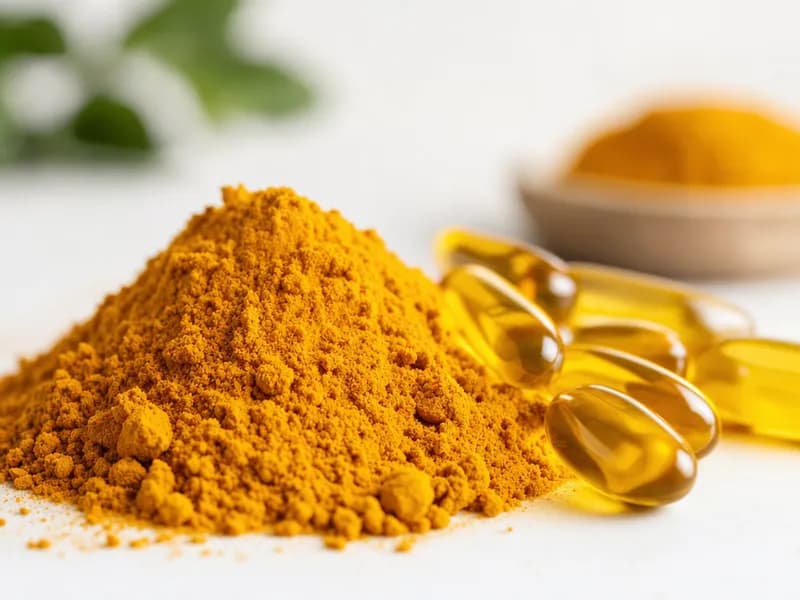
Curcumin is the yellow polyphenol that gives turmeric its color and most of its biological activity. The mechanism is well-mapped: it modulates NF-κB, COX-2, and several inflammatory cytokines. Clinically, the strongest evidence sits in osteoarthritis pain, depression, and exercise-induced muscle damage. Some trials have shown curcumin matching ibuprofen for knee osteoarthritis pain at 1,500 mg/day, which is the kind of comparison that drives both consumer interest and regulatory caution.
The formulation problem with curcumin is bioavailability. Unformulated curcumin powder is absorbed at less than 1% of the oral dose. Which means most of the early studies showing benefit were either using high doses (1,500 to 3,000 mg/day) or formulations the consumer market hadn't yet adopted. The modern category is built around bioavailability-enhanced forms: Meriva (phytosomal curcumin), Theracurmin (nanoparticulate), Longvida (solid lipid particles), BCM-95 (with turmeric essential oils), and Curcumin C3 Complex (paired with piperine from black pepper). Each one has its own absorption data and its own licensing terms.
For brands, the decision is mostly between piperine-paired generic curcumin (cheapest, oldest research base) and the branded bioavailable forms (higher cost, better absorption story, brand-name marketing rights). For mass retail and price-sensitive positioning, generic + piperine works. For clinical, premium, and women's-wellness positioning, the branded extracts are the right call.
Osteoarthritis, depression, exercise recovery, and inflammatory markers. Few botanicals have RCT evidence across this many positioning angles.
Meriva, Theracurmin, Longvida, and BCM-95 all come with clinical studies and label-mark licensing. Useful for differentiation against private-label competitors.
Works in joint, mood, recovery, women's health, and longevity formulas. One active extends across multiple SKUs.
Generic curcumin with piperine: 1,000 to 1,500 mg/day in 2 to 3 divided doses. Branded bioavailable forms: 200 to 500 mg/day per the specific extract's clinical data.
The published minimums and typical costs for Bioavailable Curcumin. Every project gets an itemized quote covering your format, ingredients, and packaging.
| Dosage form | Minimum order |
|---|---|
| Bioavailable Curcumin capsules | from 2,000 units |
| Bioavailable Curcumin tablets | from 2,000 units |
| Bioavailable Curcumin liquids | from 2,000 units |
| Bioavailable Curcumin softgels | from 3,000 units |
| Bioavailable Curcumin gummies | from 3,000 units |
6 to 10 weeks from the catalog (network range 4 to 12 weeks). A custom formula takes 8 to 12 weeks before production.
2,000 units usually lands at USD $8,000 to $15,000 all-in, depending on format, ingredient grade, and packaging.
GMP-certified manufacturing, a third-party ISO 17025 Certificate of Analysis on every batch, regulatory handling, and one account lead.
Formula feasibility reviews are free. Get an itemized quote for your format and volume.
Curcumin (and turmeric) is covered by an NPN monograph with defined dose ranges and joint/anti-inflammatory claim language. NPN submission is well-trodden.
Established dietary ingredient under DSHEA. Structure-function claim language around joint comfort and inflammatory response is well-supported. Avoid disease-specific claim language ("treats arthritis").
Claim language must be reviewed for your specific product and market before use. Not all claims are permitted in every jurisdiction.
Selected peer-reviewed studies, plus the demand signals we're seeing from brands, retailers, and consumer search behaviour.
Hewlings SJ, Kalman DS. · Foods · 2017
Frequently-cited overview of curcumin's clinical evidence and bioavailability constraints. Useful reference document for substantiation files.
Kuptniratsaikul V, Dajpratham P, Taechaarpornkul W, et al. · Clinical Interventions in Aging · 2014
Head-to-head trial showing turmeric extract matched ibuprofen for knee osteoarthritis pain over 4 weeks. Foundational for joint-positioning claims.
Lopresti AL, Drummond PD. · Journal of Affective Disorders · 2017
Curcumin (with or without saffron) reduced depression and anxiety symptoms in adults with MDD over 12 weeks. Extends curcumin positioning into mood support.
Jamwal R. · Nutrire · 2018
Head-to-head comparison of bioavailable curcumin delivery forms. The reference document brands use when choosing between Meriva, Theracurmin, Longvida, and BCM-95.
Curcumin held steady as the #1 herbal supplement by US dollar sales for over a decade and remains a foundational botanical in joint and inflammation formulas.
Curcumin is the rare ingredient where the consumer narrative is mature, the clinical file is broad, and the formulation question still has real implications for product performance. Unlike trendier ingredients with shorter consumer attention cycles, curcumin's growth has been incremental and durable. The growth area in 2025 is mood and women's wellness. Driven by RCTs showing antidepressant effects in MDD and by the broader "chronic inflammation as the root of everything" wellness narrative. Brands launching curcumin now need to pick a specific positioning angle (joint, mood, recovery, longevity) rather than launching a generic "turmeric supplement."
References are provided for educational purposes. Citations do not constitute medical claims or guarantee outcomes. Structure-function claim language must be reviewed for your specific product and market.
For Bioavailable Curcumin the floors are capsules from 2,000 units, tablets from 2,000 units, liquids from 2,000 units, softgels from 3,000 units, gummies from 3,000 units. These are entry minimums. The same formula scales past 100,000 units as it sells.
A white-label or private-label Bioavailable Curcumin product from our 800+ formula catalog typically runs 6 to 10 weeks, and 4 to 12 weeks across the full network depending on which facility takes the run. A custom Bioavailable Curcumin formula takes 8 to 12 weeks to reach a production-ready formulation, then production on top.
A first run of 2,000 units is usually USD $8,000 to $15,000 all-in, depending on format, ingredient grade, and packaging. That covers formulation work, regulatory, packaging, quality testing, and the production run itself. Coordinated through us a project typically lands 20 to 40% below managing the same production in-house. You get an itemized quote before committing.
Canada: Curcumin (and turmeric) is covered by an NPN monograph with defined dose ranges and joint/anti-inflammatory claim language. NPN submission is well-trodden. United States: Established dietary ingredient under DSHEA. Structure-function claim language around joint comfort and inflammatory response is well-supported. Avoid disease-specific claim language ("treats arthritis"). We prepare and file the NPN application for Canada and handle FDA facility registration and DSHEA label review for the US, including bilingual labels for dual-market SKUs.
Generic curcumin with piperine: 1,000 to 1,500 mg/day in 2 to 3 divided doses. Branded bioavailable forms: 200 to 500 mg/day per the specific extract's clinical data. We formulate to the dose your claims need and confirm it against the monograph or claim path for your market before the run.
Generic curcumin needs 5 to 20 mg of piperine to absorb meaningfully. The exception matters: skip piperine if your customers are likely to be on prescription medications, because it interacts with CYP3A4 substrates. Treat that as a formulation decision with real consequences for who can safely take your product.
Often, because they change the dose. Meriva, Theracurmin, and Longvida work at 100 to 500 mg per serving against roughly 1,500 mg for generic curcumin, which shrinks the capsule count and improves compliance. Whether that is worth the per-gram premium depends on your retail tier.
Curcumin stability in liquid and gummy formats is limited, and the ingredient is bright orange-yellow and stains everything it touches, so capsules need opaque shells and powder formats discolor. These formats need an experienced manufacturer, which is part of what we match you to.
Curcumin and piperine both inhibit CYP3A4, so drug-interaction risk is real and required warnings vary by jurisdiction. Recent hepatotoxicity case reports, particularly with high-dose piperine-paired products, also warrant a conservative position on the dose you recommend on the label.
Tell us about your product concept and we'll put together a formulation, sourcing, and manufacturing plan tailored to your brand, format, and market.