11 min read
The GLP-1 Off-Ramp: Opportunity for Supplement Founders
When consumers stop GLP-1 drugs like Ozempic, rapid weight regain creates a supplement opening. Here's how brand founders can position for the GLP-1 off-ramp.
The women's-wellness ingredient quietly winning the PCOS and fertility category.
Myo-inositol and D-chiro-inositol, dosed at the physiological 40:1 ratio found in human plasma, are the foundation of the modern PCOS, fertility, and metabolic-women's-health category. Quiet evidence base, growing consumer demand.
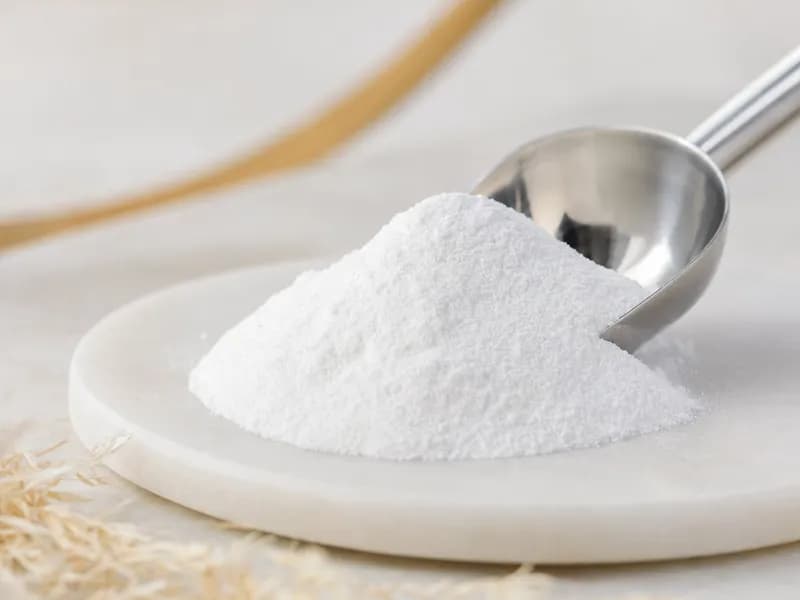
Inositol is a B-vitamin-like compound that exists in nine stereoisomers, two of which matter for supplements: myo-inositol (the most abundant) and D-chiro-inositol (a downstream metabolite). Both play roles in insulin signaling, ovarian follicle development, and neurotransmitter regulation. The 40:1 myo to D-chiro ratio reflects the natural balance in human plasma and is the dose pattern that gets the strongest results in PCOS and fertility trials.
For the supplement market, this is one of the quieter category-leaders. Inositol doesn't get TikTok virality, but it sits at the center of PCOS and fertility communities, where physician-recommended use has pushed steady consumer demand for over a decade. Meta-analyses support its use for cycle regularity, ovulation, metabolic markers in PCOS, and mood symptoms. The active price point is reasonable, the format options are flexible, and the consumer is highly engaged once you reach them.
The formulation question is mostly about whether to launch a single-ingredient inositol or a more complete women's-metabolic stack. Single-active products work for clinical-channel and OB/GYN-recommended positioning. Stacks combining 40:1 inositol with vitamin D, folate (5-MTHF preferred for PCOS-associated MTHFR polymorphism), N-acetylcysteine, and chromium are the standard build for premium DTC. The 4 g/day dose is bulky. Most products land at 2,000 mg per scoop in a powder format, so the consumer takes one scoop morning and night.
Strong clinical evidence and OB/GYN-recommended status make inositol the default first-line nutritional support in PCOS. Few categories have this kind of physician anchor.
No TikTok cycle to ride or recover from. Steady search demand for over a decade, growing modestly each year. The kind of base demand that supports a stable product line.
Cycle support, mood, prenatal preparation, metabolic balance. One active anchors multiple SKUs across a women's-health brand.
4 g myo-inositol + 100 mg D-chiro-inositol daily, in two divided doses.
The published minimums and typical costs for Inositol. Every project gets an itemized quote covering your format, ingredients, and packaging.
| Dosage form | Minimum order |
|---|---|
| Inositol powders | from 1,000 units |
| Inositol capsules | from 2,000 units |
6 to 10 weeks from the catalog (network range 4 to 12 weeks). A custom formula takes 8 to 12 weeks before production.
2,000 units usually lands at USD $8,000 to $15,000 all-in, depending on format, ingredient grade, and packaging.
GMP-certified manufacturing, a third-party ISO 17025 Certificate of Analysis on every batch, regulatory handling, and one account lead.
Formula feasibility reviews are free. Get an itemized quote for your format and volume.
Myo-inositol and D-chiro-inositol are listed in the NHPID and supported by Health Canada monographs. NPN submissions for women's-health claim language follow established paths.
Sold as dietary ingredients under DSHEA with established structure-function claim history. Avoid disease-specific language ("treats PCOS," "restores fertility") in US labeling.
Claim language must be reviewed for your specific product and market before use. Not all claims are permitted in every jurisdiction.
Selected peer-reviewed studies, plus the demand signals we're seeing from brands, retailers, and consumer search behaviour.
Giordano D, Corrado F, Santamaria A, et al. · Menopause · 2011
2 g of myo-inositol twice daily improved insulin sensitivity, HOMA-IR, and lipid profile in postmenopausal women. Bridges inositol use beyond reproductive-age PCOS.
Unfer V, Facchinetti F, Orrù B, et al. · Endocrine Connections · 2017
Systematic review of myo-inositol and D-chiro-inositol in PCOS management. The reference document behind the 40:1 ratio recommendation now standard in clinical practice.
Showell MG, Mackenzie-Proctor R, Jordan V, et al. · Cochrane Database of Systematic Reviews · 2018
Pooled RCT data showing inositol may improve metabolic and ovulation outcomes in PCOS. Cochrane's standard rigor makes this an unusually credible citation.
Nordio M, Proietti E. · European Review for Medical and Pharmacological Sciences · 2012
Established that the 40:1 myo to D-chiro ratio outperforms either alone or in different ratios on metabolic and ovulation endpoints in PCOS.
Inositol's growth is steady and physician-driven. Google search interest has grown roughly 15 to 20% per year for five consecutive years without a viral spike.
Inositol is the women's-health category's quiet workhorse. There's no TikTok moment in its history; growth has come almost entirely from PCOS patient communities (Reddit's r/PCOS, dedicated Facebook groups), OB/GYN and reproductive-endocrinology recommendations, and word-of-mouth in fertility-focused circles. The brands winning here aren't loud. They're educational, physician-credentialed, and present in clinical channels alongside DTC. Ovasitol (Theralogix) is the historic clinical-channel leader; Wholesome Story, Inositum, and Inofolic each hold pieces of the consumer market. Room remains for new entrants with strong educational content and clinical positioning.
References are provided for educational purposes. Citations do not constitute medical claims or guarantee outcomes. Structure-function claim language must be reviewed for your specific product and market.
For Inositol the floors are powders from 1,000 units, capsules from 2,000 units. These are entry minimums. The same formula scales past 100,000 units as it sells.
A white-label or private-label Inositol product from our 800+ formula catalog typically runs 6 to 10 weeks, and 4 to 12 weeks across the full network depending on which facility takes the run. A custom Inositol formula takes 8 to 12 weeks to reach a production-ready formulation, then production on top.
A first run of 2,000 units is usually USD $8,000 to $15,000 all-in, depending on format, ingredient grade, and packaging. That covers formulation work, regulatory, packaging, quality testing, and the production run itself. Coordinated through us a project typically lands 20 to 40% below managing the same production in-house. You get an itemized quote before committing.
Canada: Myo-inositol and D-chiro-inositol are listed in the NHPID and supported by Health Canada monographs. NPN submissions for women's-health claim language follow established paths. United States: Sold as dietary ingredients under DSHEA with established structure-function claim history. Avoid disease-specific language ("treats PCOS," "restores fertility") in US labeling. We prepare and file the NPN application for Canada and handle FDA facility registration and DSHEA label review for the US, including bilingual labels for dual-market SKUs.
4 g myo-inositol + 100 mg D-chiro-inositol daily, in two divided doses. We formulate to the dose your claims need and confirm it against the monograph or claim path for your market before the run.
Current evidence favors the 40:1 physiological ratio, which is 4 g of myo-inositol to 100 mg of D-chiro-inositol daily. Older trial protocols used 1:1 and some products still follow them; we would not build a new formula that way.
Powder is the practical choice here. A 4 g daily dose translates to six to ten capsules per day, which destroys compliance. Myo-inositol is mildly sweet and water-soluble so it drinks easily without masking, and powders carry the lower 1,000-unit floor.
5-MTHF (methylfolate), vitamin D3, and chromium are the conventional partners for a metabolic and women's health stack. Note that D-chiro-inositol runs two to three times the per-gram cost of myo, so the ratio has a real bearing on your landed cost.
Disease claims are off-limits in both Canada and the US, but structure-function language still has to resonate with an audience that knows this category well and reacts badly to hedging. Getting that balance right is claim-writing work we do before the label is finalized.
Tell us about your product concept and we'll put together a formulation, sourcing, and manufacturing plan tailored to your brand, format, and market.