11 min read
The GLP-1 Off-Ramp: Opportunity for Supplement Founders
When consumers stop GLP-1 drugs like Ozempic, rapid weight regain creates a supplement opening. Here's how brand founders can position for the GLP-1 off-ramp.
The calm-without-sedation amino acid behind the modern focus stack.
L-theanine is an amino acid found in green tea leaves that produces relaxation without sedation. It's the active behind most caffeine-pairing focus products and a common addition to sleep formulas with magnesium or apigenin.
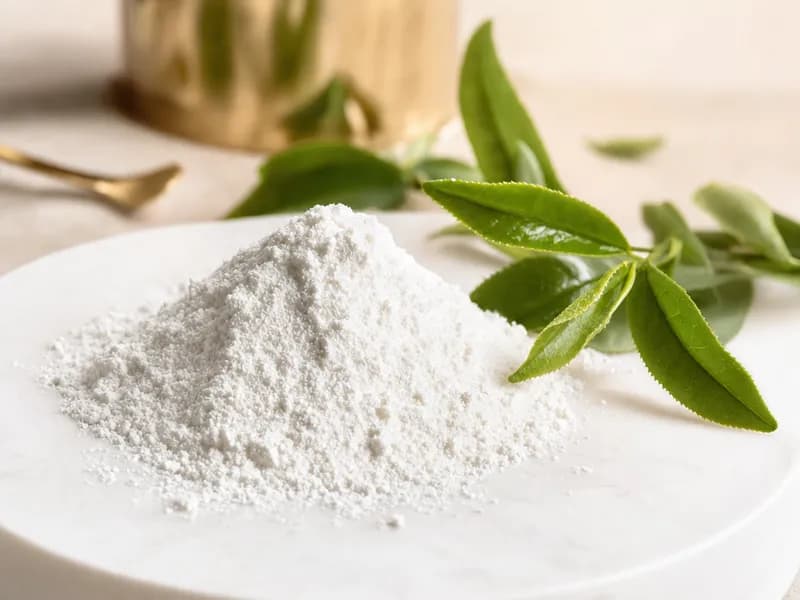
L-theanine is a non-protein amino acid that occurs naturally in Camellia sinensis (green tea). It crosses the blood-brain barrier and modulates alpha-wave activity, GABA, and glutamate signaling. All without sedating effect. That mechanism is what gives L-theanine its core marketing position: calm and focus without drowsiness, which makes it the standard pairing with caffeine in nootropic and pre-workout products.
The two main commercial sources are Suntheanine (Taiyo Kagaku's branded enzymatically-produced form, the one most clinical studies use) and generic fermentation-derived L-theanine. Suntheanine carries a licensing premium and clinical-study citation rights; generic L-theanine costs less but won't get you the Suntheanine logo on the label. For a launch where ingredient credibility matters (clinical channel, brand-aware DTC) Suntheanine is usually worth it. For mass-market and white-label, generic is fine.
The two product positions L-theanine has owned for years are: paired with 100 mg caffeine for focus and energy without jitter, and paired with magnesium glycinate or apigenin for sleep onset. The new positioning that's growing in 2025 is standalone. "calm without coffee," a midday-focus product for consumers reducing their caffeine intake.
L-theanine + caffeine in a 2:1 ratio is the most-cited nootropic stack in consumer wellness. Easy claim story, easy formulation.
One amino acid serves three of the largest growth categories. Few ingredients give you that kind of formulation flexibility.
No common side effects at typical doses. Compatible with nearly every other supplement active without interaction concerns.
100 to 200 mg per serving for focus and stress positioning; 200 to 400 mg for sleep applications.
The published minimums and typical costs for L-Theanine. Every project gets an itemized quote covering your format, ingredients, and packaging.
| Dosage form | Minimum order |
|---|---|
| L-Theanine capsules | from 2,000 units |
| L-Theanine tablets | from 2,000 units |
| L-Theanine gummies | from 3,000 units |
6 to 10 weeks from the catalog (network range 4 to 12 weeks). A custom formula takes 8 to 12 weeks before production.
2,000 units usually lands at USD $8,000 to $15,000 all-in, depending on format, ingredient grade, and packaging.
GMP-certified manufacturing, a third-party ISO 17025 Certificate of Analysis on every batch, regulatory handling, and one account lead.
Formula feasibility reviews are free. Get an itemized quote for your format and volume.
L-theanine has a Health Canada monograph with defined dose ranges and stress/focus claim language. Straightforward NPN path.
Sold as a dietary ingredient under DSHEA with established structure-function claim history. GRAS for food and beverage applications.
Claim language must be reviewed for your specific product and market before use. Not all claims are permitted in every jurisdiction.
Selected peer-reviewed studies, plus the demand signals we're seeing from brands, retailers, and consumer search behaviour.
Hidese S, Ogawa S, Ota M, et al. · Nutrients · 2019
200 mg L-theanine daily for 4 weeks reduced stress symptoms and improved verbal fluency and executive function in healthy adults.
Kahathuduwa CN, Dassanayake TL, Amarakoon AM, Weerasinghe VS. · Nutritional Neuroscience · 2017
Demonstrated that L-theanine + caffeine produces sustained attention gains beyond either alone. The citation behind nearly every focus product on the market.
Williams JL, Everett JM, D'Cunha NM, et al. · Journal of Functional Foods · 2020
Pooled trial evidence supporting attention and reaction-time benefits at 200 mg doses. Reasonable foundation for cognitive-claim substantiation.
Gomez-Ramirez M, Higgins BA, Rycroft JA, et al. · Brain Topography · 2009
EEG evidence that L-theanine increases alpha-band activity during attention tasks. The mechanism citation behind "calm focus" claim language.
Searches for "L-theanine" have grown steadily for five consecutive years, with the largest 2024 spikes tied to TikTok focus-stack content.
L-theanine is one of the most quietly successful ingredients in modern supplements. It doesn't have a single viral moment in its history, but it has become the default companion to caffeine in nearly every nootropic, pre-workout, and "clean energy" RTD. The recent growth signal is the standalone-focus product position. Consumers using L-theanine without caffeine as a daytime calm aid. Brands like Magic Mind, Magic Spoon, and others have built entire SKUs around the 100 to 200 mg L-theanine dose.
References are provided for educational purposes. Citations do not constitute medical claims or guarantee outcomes. Structure-function claim language must be reviewed for your specific product and market.
For L-Theanine the floors are capsules from 2,000 units, tablets from 2,000 units, gummies from 3,000 units. These are entry minimums. The same formula scales past 100,000 units as it sells.
A white-label or private-label L-Theanine product from our 800+ formula catalog typically runs 6 to 10 weeks, and 4 to 12 weeks across the full network depending on which facility takes the run. A custom L-Theanine formula takes 8 to 12 weeks to reach a production-ready formulation, then production on top.
A first run of 2,000 units is usually USD $8,000 to $15,000 all-in, depending on format, ingredient grade, and packaging. That covers formulation work, regulatory, packaging, quality testing, and the production run itself. Coordinated through us a project typically lands 20 to 40% below managing the same production in-house. You get an itemized quote before committing.
Canada: L-theanine has a Health Canada monograph with defined dose ranges and stress/focus claim language. Straightforward NPN path. United States: Sold as a dietary ingredient under DSHEA with established structure-function claim history. GRAS for food and beverage applications. We prepare and file the NPN application for Canada and handle FDA facility registration and DSHEA label review for the US, including bilingual labels for dual-market SKUs.
100 to 200 mg per serving for focus and stress positioning; 200 to 400 mg for sleep applications. We formulate to the dose your claims need and confirm it against the monograph or claim path for your market before the run.
They are chemically identical. The difference is that only Suntheanine ships with the rights to cite its clinical studies in your marketing. If your positioning leans on that evidence, you are buying the citations; if it does not, generic delivers the same molecule for less.
No. It is tasteless and water-soluble, which makes it one of the easiest actives to formulate. It works in capsules, gummies, ready-to-drink, stick packs, and chewables without masking work.
100 to 200 mg for focus and stress positioning, typically paired with 50 to 100 mg of caffeine. For sleep, 200 to 400 mg in the evening. The same ingredient supports both products; the dose and the pairing define which one you are selling.
Magnesium glycinate or apigenin. Both are conventional partners in a premium sleep stack, and both give the formula an additional mechanism to talk about.
Tell us about your product concept and we'll put together a formulation, sourcing, and manufacturing plan tailored to your brand, format, and market.